
Once the bell rings in Tag Team, nobody gets to change their mind about anything.
You spend your energy between rounds quietly stacking the deck.
Draft two Fighters, build your Fight Deck between rounds without ever shuffling it, then watch it play out card by card with zero say once the bell rings.
Tag Team Game Overview
Quick Rules Summary
Each player drafts a Tag Team of 2 Fighters, then builds a starting Fight Deck from their 2 Starting Cards.
The rest of each Fighter’s cards, 9 apiece, get shuffled together into an 18-card Build Deck.
A game plays out over Rounds, each made of a Fight! Step and a Build! Step.
In the Fight! Step, both players simultaneously flip the top card of their Fight Deck and resolve every Action on it, Attacks, Blocks, Heals, Power gains, Direct Damage, and so on, all mandatory.
Whoever’s card was revealed is the Active Fighter for that Turn; their teammate is the Partner, and some cards drag the Partner into the action too. You keep flipping and resolving Turns until someone’s Fight Deck runs out.
In the Build! Step, you draw the top 3 cards of your Build Deck, secretly choose 1 to slot into your Fight Deck, top, bottom, or anywhere between existing cards without rearranging what’s already there, and discard the other 2 to the bottom of the Build Deck.
That’s the entire strategic layer of the game: you’re permanently reordering a deck you’ll never get to shuffle, trying to place your pickup exactly where it’ll counter whatever your opponent seems to be building toward.
How do you win?
A Fight ends the moment a Fighter’s Health marker reaches the KO space at the end of a Turn, and their team loses.
If both sides get KO’d on the same Turn, it’s a Double KO and the Fight is judged a draw.
In the rare case a player can’t draw 3 cards for their Build Deck, that’s also ruled a draw.
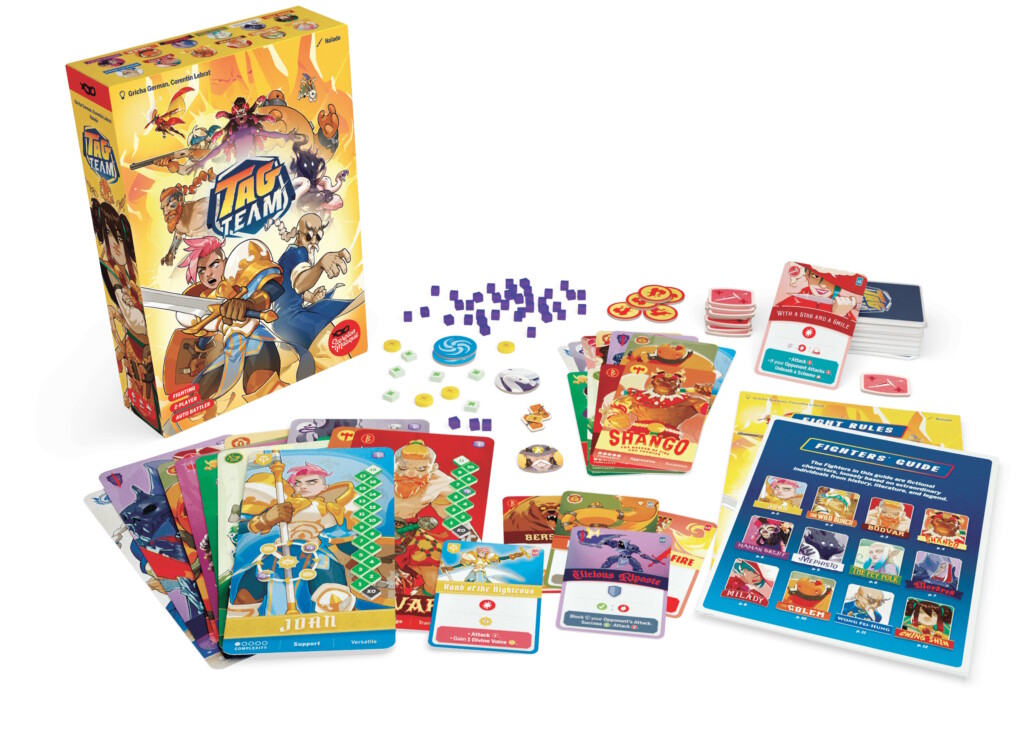
Main Mechanisms
Auto-battler card resolution, deck construction through secret ordered insertion rather than shuffling, and simultaneous, fully mandatory combat.
USP
Never shuffling your deck is the whole game. You know your own Fight Deck’s exact order because you built it card by card.
The entire skill test becomes reading your opponent, then sliding your Build Step pickup into precisely the spot that’ll punish them.
Theme
A tag-team fighting game roster played completely straight, big personalities and a varied cast.
Setup
Draft your 2 Fighters using the Draft cards, either the Standard or Competitive method, take your Fighter boards, Health markers and starting Power cubes, decide the order of your 2 Starting Cards to form your opening Fight Deck, then shuffle your Fighters’ remaining cards into your 18-card Build Deck. Light and quick.
Components & Artwork
Colourful Fighter boards and character art that carries a lot of personality for a card-driven game, plus a handful of Fighter-specific tokens that give certain characters their own flavour.
Ease of Teaching
Flip a card, resolve everything on it; that’s a one-minute explanation.
What takes longer is everything sitting underneath it: mandatory Actions you can’t opt out of, Health Track icons that trigger on movement, Partner and Opponent’s Partner targeting, and keywords like THEN that dictate resolution order.
The Build Step is the one moment of real decision-making each round, and it’s simple once you’ve seen the Fight Step in action.
Similar Games
Challengers is the obvious comparison, same auto-battler-meets-deckbuilder structure where cards get added to a deck between bouts.
Tag Team Review
Positives
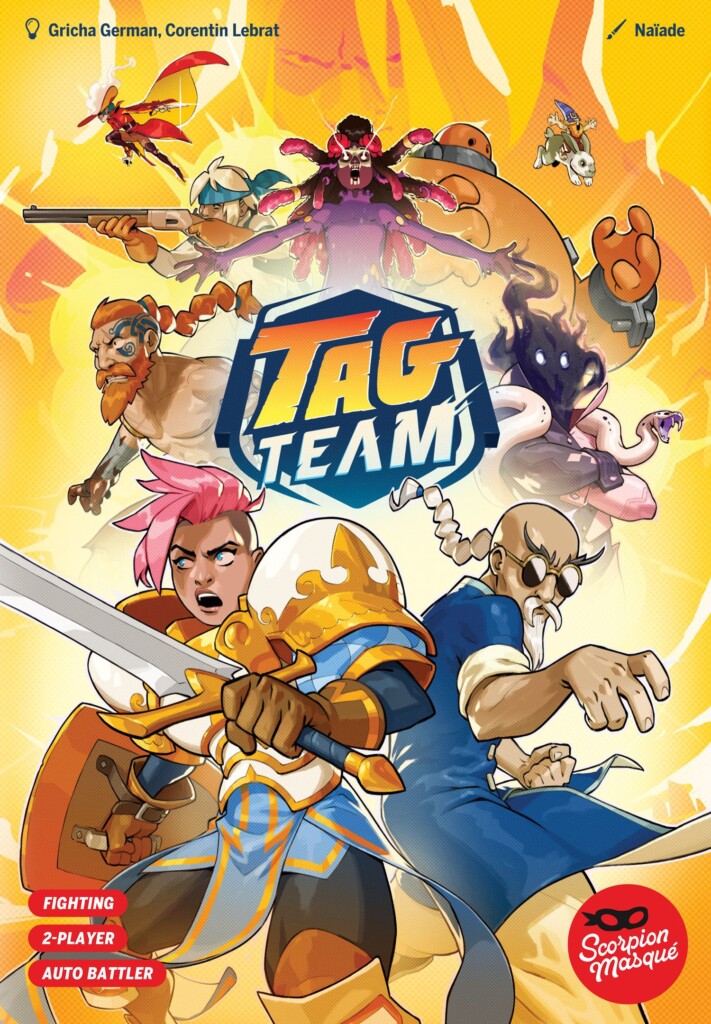
The art is fun.
The Fighter roster has personality, and the variability between characters means drafting a different pair actually changes how a fight feels.
The card reveals carry drama, watching two Fight Decks collide Turn by Turn.
Negatives
The randomness is real. You never know what your opponent is about to flip, so a huge amount of how a Turn plays out is just finding out together rather than deciding anything.
That ties into the bigger issue: once the Fight! Step starts, there isn’t much choice left at all.
Summary
A good-looking, characterful auto-battler where the real game happens in the quiet moments between fights rather than during them.
Fun to watch unfold, but if you want to be making choices while the cards are actually flipping, this isn’t going to scratch that itch.
Jesta ThaRogue


Leave a Reply