
Somewhere out there is a planet made almost entirely of gemstones.
Drillers hands you a mech, a fuel gauge, and permission to dig straight through it.
Pilot your mech deeper into the mine, drill up minerals and mine tiles for points, then surface to spend, repair and upgrade before diving back down.
Drillers Game Overview
Quick Rules Summary
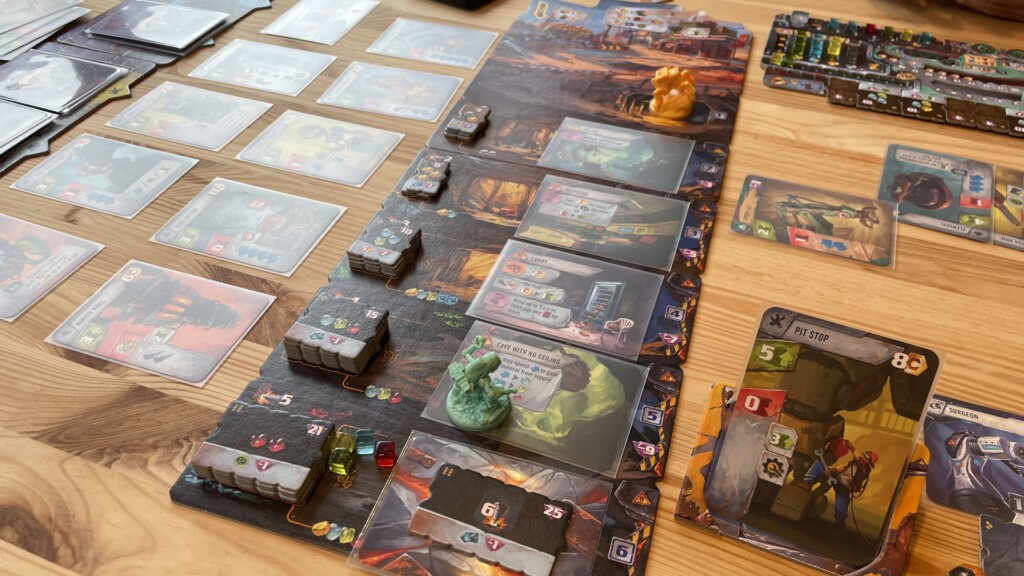
Drillers is played across seven floors: the surface, the mine entrance, and five floors of mine below it. Each turn runs through three phases: Operations, Surfacing (only if you end Operations on the surface), and Upkeep.
During Operations, you freely mix moving, drilling and playing cards in any order, as many times as you can afford.
Every card gives you a choice: play it for its often fuel-hungry main effect, play it purely to generate fuel, or hold onto one card for free between turns.
Fuel powers movement between floors and drilling, which you spend to collect minerals on your current floor, excavate a corridor tile (adding its minerals to the floor and a mine tile to your progress track), or remove a barrier blocking the floor below.
If you end your turn on the surface, you get a Surfacing phase: sell your stored minerals for credits, repair away 1 unwanted card, discard cards for credits, upgrade your fuel or storage capacity, refuel to full, and buy new cards from the four shops.
Bought cards go straight on top of your deck rather than into a shuffled pile, so you always know exactly what you’re drawing next turn.
Upkeep closes things out: pay fuel to keep any cards you didn’t play, discard the rest, and draw 3 fresh ones.
How do you win?
The game ends the moment a player’s progress track fills, which happens when the mine tiles they’ve collected catch up with the mineral cubes sitting in their own overflow zone.
This means selling too many minerals into overflow quietly speeds up your own endgame.
That player takes a final milestone worth a flat 18 points, everyone else gets one last turn, and then scores are totalled: points for every mine tile and mineral you’re holding, 1 point per 5 leftover credits, and points for any milestones claimed along the way.
You then lose points for how deep your mech still is in the mine and for any negative-value cards still clogging your deck, so getting your mech back to the surface with a clean deck matters almost as much as what you dug up.
Main Mechanisms
Deck building where purchases go straight on top of your deck instead of being shuffled in, fuel and drilling resource management, and a vertical push-your-luck between the surface shops and the mine’s rewards.
USP
The deck is played face up so you also know your next card.
Theme
A mining setting, more grimy sci-fi workplace than epic fantasy.
Setup
A genuine step up from a quick card game: 7 floors of board, sorted corridor stacks, shuffled floor cards, 4 shops to deal out, and individual dashboards and starting decks to assemble for every player.
Give yourself ten minutes.
Components & Artwork
The mech miniatures and the folding mine board look great on the table.
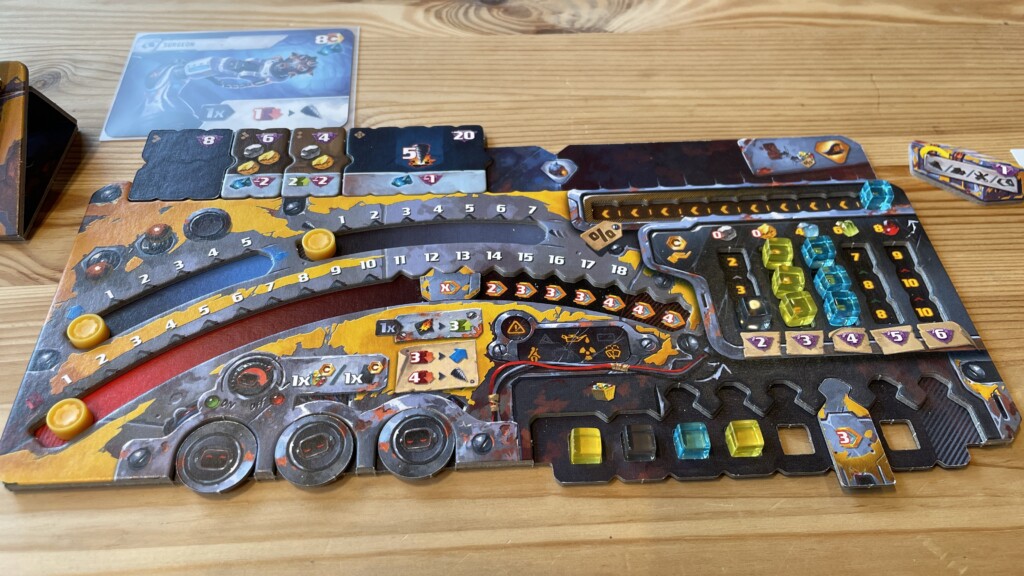
The boards do a good job of keeping fuel, storage and progress visible at a glance.
Ease of Teaching
The core game loop, drill, move or dig, sell what you find, is easy to explain in a couple of minutes.
The rest of it is a bit fiddly at first.
Similar Games
Mines of Zavandor is the obvious pull for the mineral collecting and market-selling angle, though Drillers turns that into something far more tactile with an actual mine to dig through.
Clank! covers similar ground on the movement side, diving deeper for rewards while managing the risk of getting back to the surface
Thunderstone Quest shares enough deck-building DNA, buying cards to strengthen a personal engine, that fans of one should feel at home in the other.
Drillers Review
Positives
It’s simple to pick up and quick to actually play once everyone knows their dashboard.
It looks great too, from the mech minis to the mine board itself.
Chaining moves, drills and card effects into one big Operations phase is satisfying.
Negatives
There’s a bit of a runaway leader risk.
Turn length varies a lot from player to player; uneven turn lengths can mean real downtime.
Summary
A good-looking, well-combo’d deck builder that earns its “good game” label, quick to teach and satisfying to chain together.
Even if the pace between players isn’t always as even as the pace of your own turn.
Jesta ThaRogue


Leave a Reply