

Eldertide: A Thousand Lights has you avoid a storm to collect resources.
…and repair everything in its trail.
Players lead one of five houses of a once-mighty seafaring nation, now rising to reclaim their homeland from a devastating supernatural storm that has raged for decades.
How to play Eldertide: A Thousand Lights
A quick and concise tutorial including the solo rules.
Quick Rules Summary
At the start of every round, each player secretly sets a Navigation Dial to a number from 1 to 8, or to the Capital icon, then everyone reveals simultaneously.
That single number becomes your Channel Value for the round, and it does three jobs at once.
- How many Sail Points you have to move between adjacent Ports
- Initiative order (highest goes first)
- Which of a Port’s three actions you’re allowed to perform
You immediately spend that much Qi Energy from your ship’s tank to pay for it.
Once you’ve sailed, you take a Main Action at your destination Port, then an optional Bonus Action from an adjacent Port or to build a Beacon.
Choosing the Capital icon instead sends you home to refill your Qi tank, build Facilities, and advance tracks instead of sailing.
At the end of each round, the Storm Phase rolls a die to move the Storm standee, breaking whatever Port it lands on and damaging any ship caught there.
How do you win?
The game runs 10 rounds. At the end, you tally Reputation Points from your Specialisation Track levels, your Outpost Beacons, and any House Perks you’ve unlocked and activated along the way. Most Reputation Points wins.
Main Mechanisms
Pick-up-and-deliver route planning, a single hidden dial selection that triggers a bit of “push-your-luck” across movement, turn order and action strength all at once.
USP
Spending one number on three different things at the same time is the whole hook.
Go high, and you can sail further, act stronger, and go first, but you’re burning through Qi.
Go low, and you conserve fuel at the cost of going last and being stuck with the weakest Port actions.
Theme
A storm-ravaged archipelago rebuilding itself with ancient Qi crystals and spirit-blessed ships.
Setup
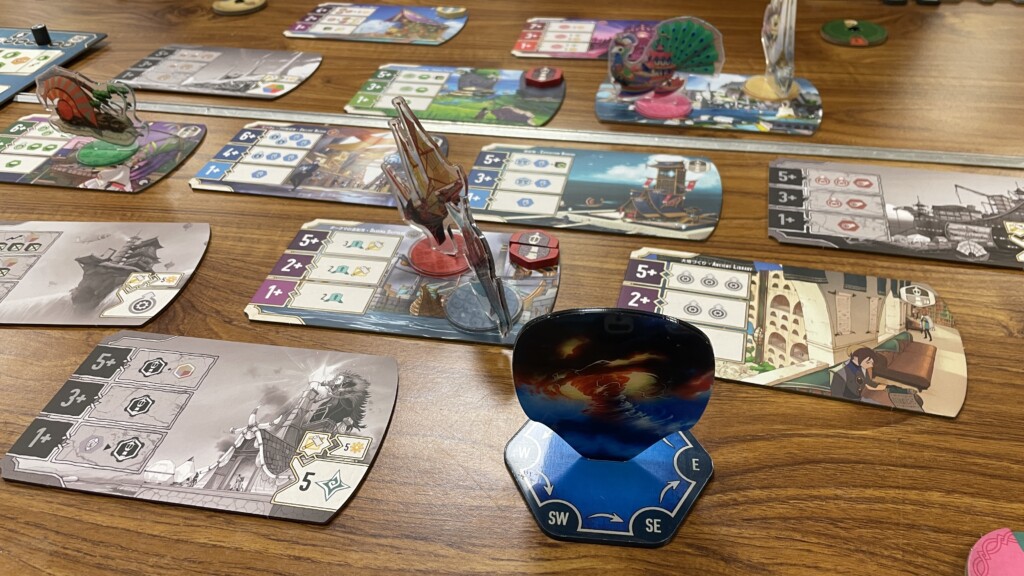
A proper sit-down. Port tiles scattered around the Capital, five asymmetric House dashboards, Specialisation Tracks, Export cards, the Beacon Reward board, and the Storm die and standee all need placing before anyone moves a ship. Fifteen to twenty minutes the first time.
Components & Artwork
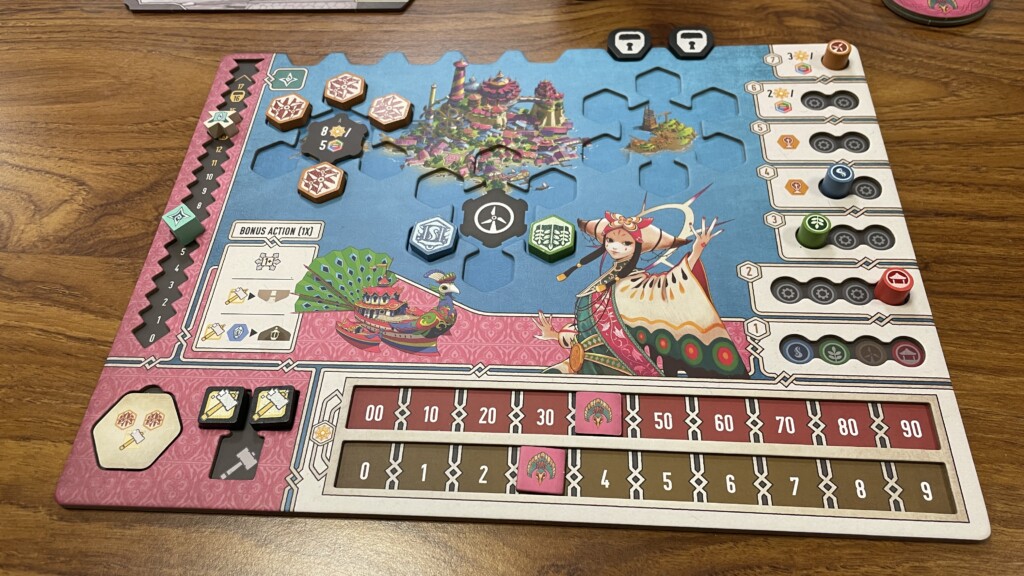
The asymmetric House dashboards and Foundation Ship and Storm standees give the table real presence. One of those people stop by the table to look at.
Ease of Teaching
The core dial concept is simple to state but takes a round or two to actually feel in your hands. The Specialisation Track limits, two-part shared Beacons, and the shifting Export demand chart take a bit of time.
Similar Games
This sits in the broader pick-up-and-deliver resource management space rather than echoing any one specific title.
Eldertide: A Thousand Lights Review
Positives
The art and production both sell the setting well.
The gameplay is interesting.
The asymmetry between the five Houses is substantial; each one plays meaningfully differently rather than just offering a different player colour.
Negatives
The Storm is a genuine source of frustration, which Port it breaks and which ship it damages comes down to a die roll.
I’m also not sure yet how it holds up over a lot of plays.
Summary
A striking, mechanically interesting pick-up-and-deliver game built around one clever dial decision, held back slightly by a Storm that can undo good planning on a bad roll. Early signs are good; this one’s staying on the shelf to find out if it has the legs.
Jesta ThaRogue
Eldertide: A Thousand Lights Tutorial

Leave a Reply