
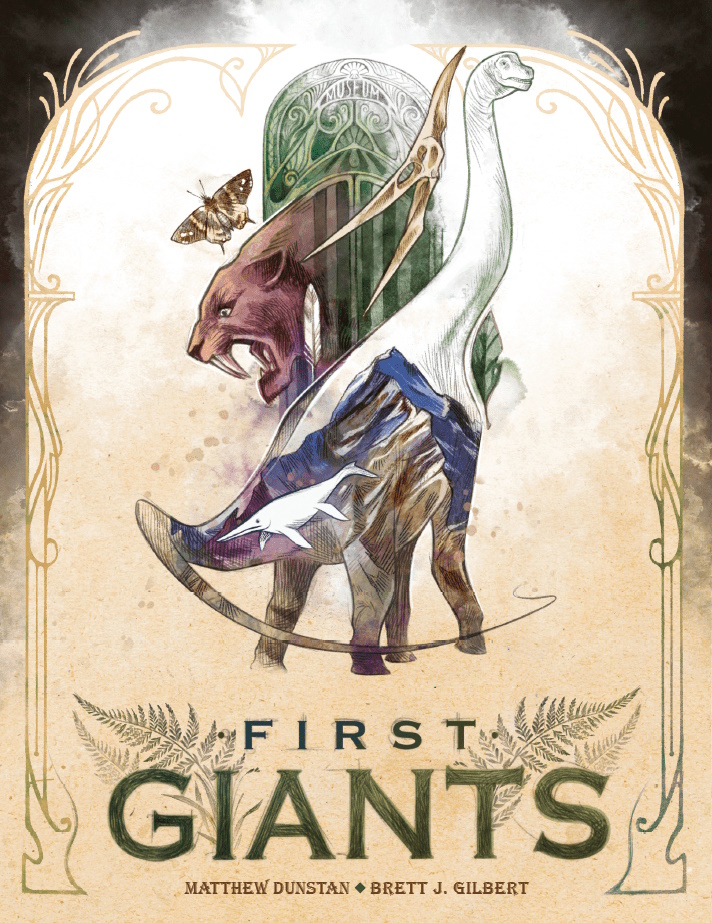
Dinosaurs have been dead for millions of years, and apparently that’s no reason to stop putting them to work.
First Giants casts you as a palaeontologist who studies fossils purely for what they can do for you.
Study fossils for their abilities, then decide when to lock them away in your display for good.
How to play First Giants
A quick and concise how to play video for First Giants.
First Giants Game Overview
Quick Rules Summary
You are a palaeontologist competing to fill a museum with the most impressive fossil displays.
On your turn, you do one of two things: place a marker at a Dig Site, or reclaim all your placed markers from Dig Sites.
Taking a card triggers its effect once taken, or triggers every time its condition is met while it’s in your Study.
When reclaiming markers, you choose to either gain 1 amber or display a fossil from your Study for each.
Displaying costs amber equal to the fossil’s size and permanently moves it from your Study to your display.
Displayed fossils go into sets, either a Family set (same family, different sizes) or a Size set (same size, different families).
How do you win?
Scores are totalled from Set tokens, News tokens, and anything else your fossils earned along the way. Most points wins.
Main Mechanisms
Worker placement adjacent, light engine building through card effects, and competitive set collection.
USP
Collecting and displaying Dinosaurs is not a new theme.
The game is also a retheme of Elysium, so the game isn’t unique either!
Theme
Palaeontology gets the tasteful treatment here, all fern borders and sepia sketches of sabre-toothed cats.
Setup
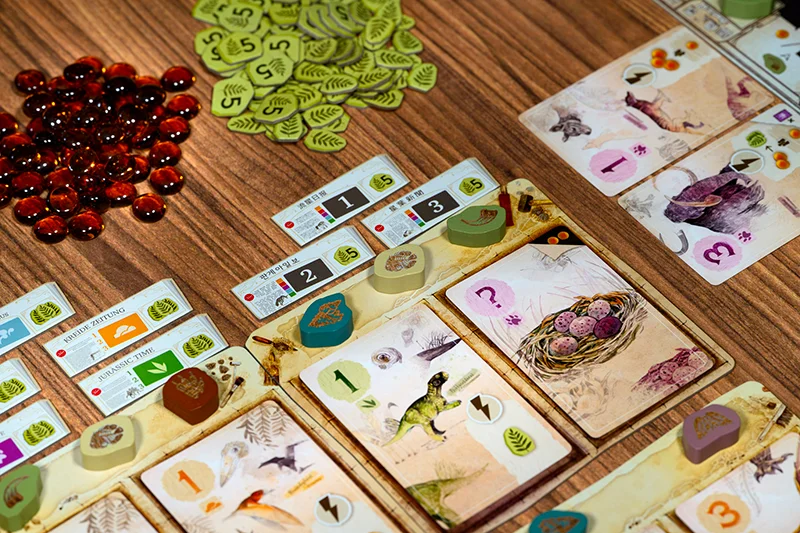
Straightforward. Shuffle the deck, deal two cards to each of the four Dig Sites, build the amber, points, News token and Set token supply based on player count, then hand everyone a Museum board and their markers.
Components & Artwork
The vintage natural history illustration suits the museum theme.
Amber, points and Set tokens are small and plentiful, and the game comes with trays, which is handy.
Ease of Teaching
Place or reclaim is easy. Where it takes longer is the card effects: the icon language covers single-use, recurring, per-opponent and per-card-in-study triggers, and new players as they go.
Similar Games
Elysium is the obvious comparison, as mentioned earlier
First Giants Review
Positives
The timing puzzle is genuinely fun.
Every card you take is a struggle between keeping it for its effect, or losing the effect and scoring it.
Dig Sites only ever offer two options, and you can’t go where you’ve been, so you have to make do with what you have access to.
Negatives
Once you know which effects are strong, there isn’t much pushing you to try the weaker ones.
The deck and token supply don’t change shape from game to game, so once you’ve found an engine you like, expect to reach for it again.
Summary
A tight, well-themed set collection game where every card asks you the same good question twice: keep this working, or bank it now. It won’t surprise you much on repeat plays, but it’ll make you think hard on every single one.
Jesta ThaRogue
First Giants Tutorial

Leave a Reply