
A Stefan Feld euro set in an enchanted forest.
If you know what that means, you already know roughly what you’re getting into.
Slip into the role of enigmatic druids journeying through an enchanted forest, earning prestige through shrines, potions, and ancient knowledge.
The Druids of Edora Game Overview
Quick Rules Summary
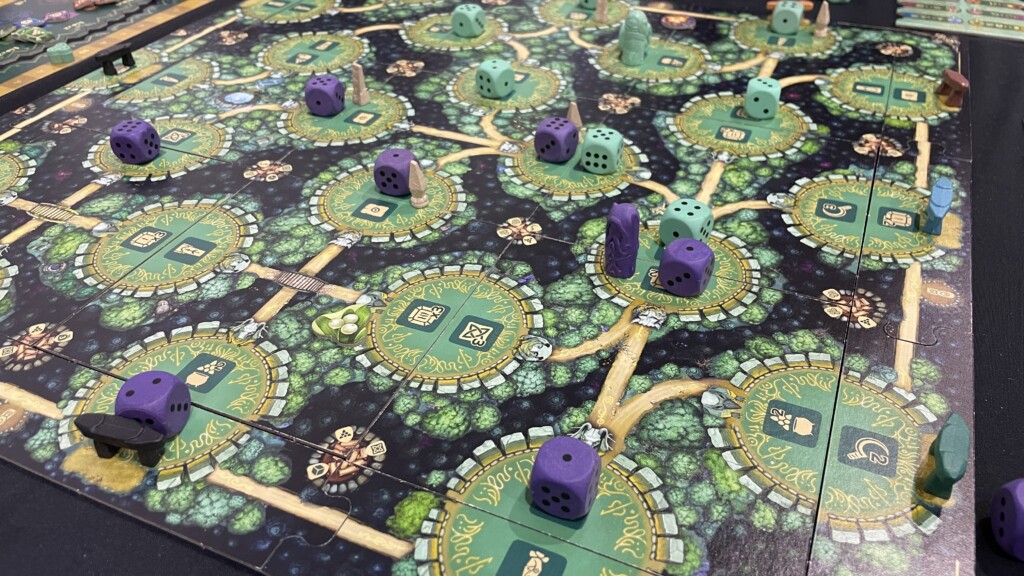
Players move their druid figure across a modular board of connected shrines, placing dice to activate actions and earn prestige points across multiple scoring tracks.
Each turn runs through seven steps. You move your figure from shrine to shrine along pathways, paying provisions for each shrine and dark forest area you pass through. Then, you place one of your personal dice on a free action field at your current shrine, paying provisions equal to the die’s face value.
You then perform the action your die landed on, collecting provisions or dice, advancing your knowledge or sickle markers, taking stone tablets, brewing potions from mistletoe, adding gemstones to your personal amulet, or erecting standing stones and runestones that remain at their shrine permanently.
Fire pits surrounded by your dice trigger bonus tiles.
Linking pairs of coloured dolmens across the board with an unbroken chain of your dice earns significant points.
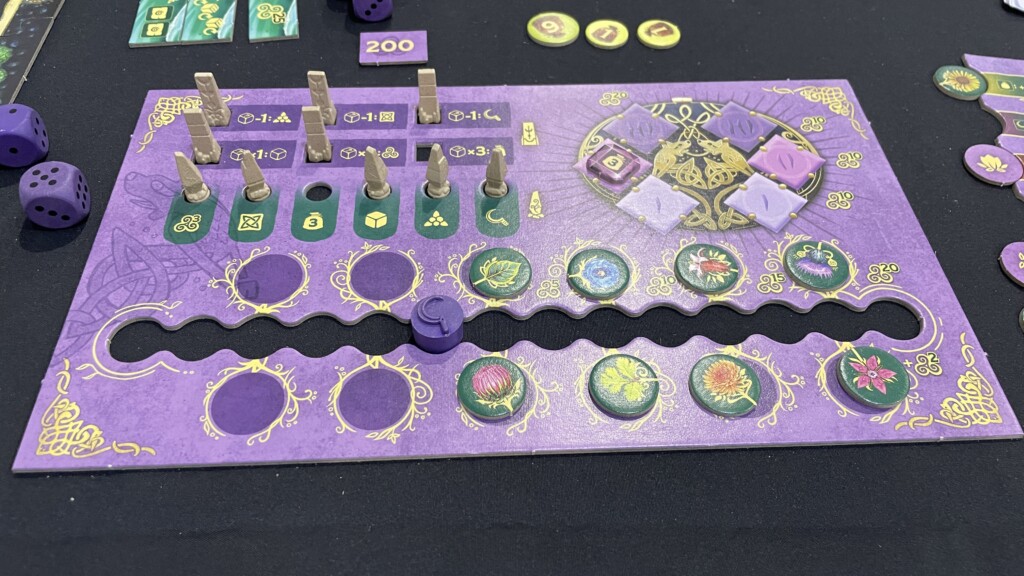
Medicinal herbs are unlocked progressively by your sickle marker and permanently enhance how certain actions work.
How do you win?
Prestige points are awarded across five end-game scoring steps: remaining resources, sickle position, completed stone tablets, amulet gemstone combinations, and a shrine takeover, where the player with the highest die at each shrine claims it, multiplied by their knowledge track position.
Main Mechanisms
Dice placement, worker movement, track advancement, engine building, and area majority.
USP
Not a truly unique USP, but the medicinal herb progression.
Each game, your herbs unlock in a different order, which shapes which actions you lean into and how your engine develops.
Theme
Celtic druid folklore is there as a light thematic layer.
Setup
The modular board assembles from seventeen pieces and is flipped or rotated depending on player count, which changes which action fields are available at each shrine. First setup takes a while.
Components & Artwork
Nice art with unique player boards. The wooden components are all nice. There’s a lot on the table when fully set up, which looks impressive.
Ease of Teaching
The turn structure is straightforward once you’ve done it once.
The challenge is the number of scoring categories and the interactions between medicinal herbs, gemstones, runestones, and the shrine takeover at game end.
Similar Games
Any Stefan Feld game is a fair comparison. The interlocking tracks, multiple scoring paths, and efficient action management are his signatures.
Bora Bora is the closest to me in feel, with similar complexity and dice placement.
The Druids of Edora Review
Positives
The theme is unique or a Euro game.
The amount you can do across a single game is impressive.
The herb variability gives each game a different feel without adding rules overhead.
Negatives
Everything is good, nothing is great. No single mechanism or moment stands out as truly memorable.
Summary
A competent, attractive, well-designed euro from one of the genre’s most consistent designers.
It does everything well and nothing great.
Jesta ThaRogue


Leave a Reply