
Next Station: Tokyo is another map-drawing, route-building puzzle.
You’re trying to build the most efficient and colourful subway network.
Travel to the city of Tokyo, Japan, and compete to redraw their metro plans in order to meet the tourist challenges of tomorrow.
Next Station: Tokyo Rules Summary
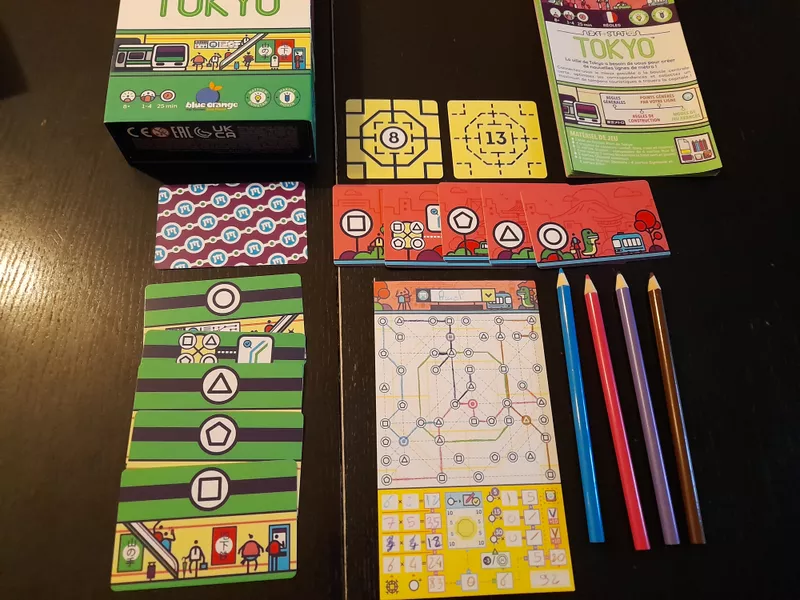
In the game, everyone has the same Tokyo map sheet and a coloured pencil. Each round, a deck of station cards is flipped one at a time, showing the next type of station you must connect your route to.
You start at your marked home station and draw a continuous line from there, adding a new segment each time a card tells you which station you’re allowed to extend to.
You’re trying to reach different districts, cross the river efficiently, and grab tourist icons as you draw. You also have to watch your own map to avoid boxing yourself in. You can get stuck as you can’t revisit the same station twice with the same line.
After a full line is drawn, you pass coloured pencils left and start a new route.
How Do You Win?
Once all of one type of card have been drawn, everyone adds up their scores for district connections, river crossings, tourist icons, and any bonuses from network synergy. The player with the most points wins.
Main Mechanisms
This is a route-drawing flip-and-write.
You’re making choices about where each line goes, balancing short-term access with long-term scoring potential. Much of the challenge is making an efficient network without cutting off future lines.
USP
This is a new version of Next Station: London and the only USP here is that it is set in Tokyo and has some unique features to this version.
Theme
The train theme works well. It is abstract, there is no denying that. But you do feel like you’re actually planning subway routes as the map slowly fills up.
Setup
Give everyone a sheet and a pencil. Shuffle the deck. That’s pretty much it.
There is a bit extra if you’re playing with the advanced scoring cards.
Components & Artwork
The map sheets are clean and clear, and the coloured pencils work perfectly for marking the different lines. The Tokyo map design looks good as the routes build out, and there’s a nice visual payoff by the end of the game.
You need to bring your own sharpener.
Ease of Teaching
It’s trickier than most roll-and-writes as the symbology isn’t instantly clear. The movement rules, district scoring, and river scoring usually need a bit of explanation.
Teaching takes longer than you’d expect for a small-box game and it also takes longer than most roll and writes.
Similar Games
Rolling Realms and Welcome To… for the roll/flip-and-write style, and Railroad Ink for the transport-route theme.
Next Station: Tokyo Review
Positives
It’s an interesting puzzle with lots of ways to score.
The four different lines give the game variety and a nice arc as your map fills up.
It looks great once all the routes are finished.
Negatives
It’s more complex than most roll-and-writes. Teaching new players can be a bit awkward.
Planning ahead can feel restrictive, and mistakes early on are hard to fix.
Summary
A decent flip and write you can add to the rotation. However, I wouldn’t make it my main choice.


Leave a Reply